Plus Minus Goals in Football
What Is Goals Plus Minus in Football and How Is It Calculated?
February 14, 2026
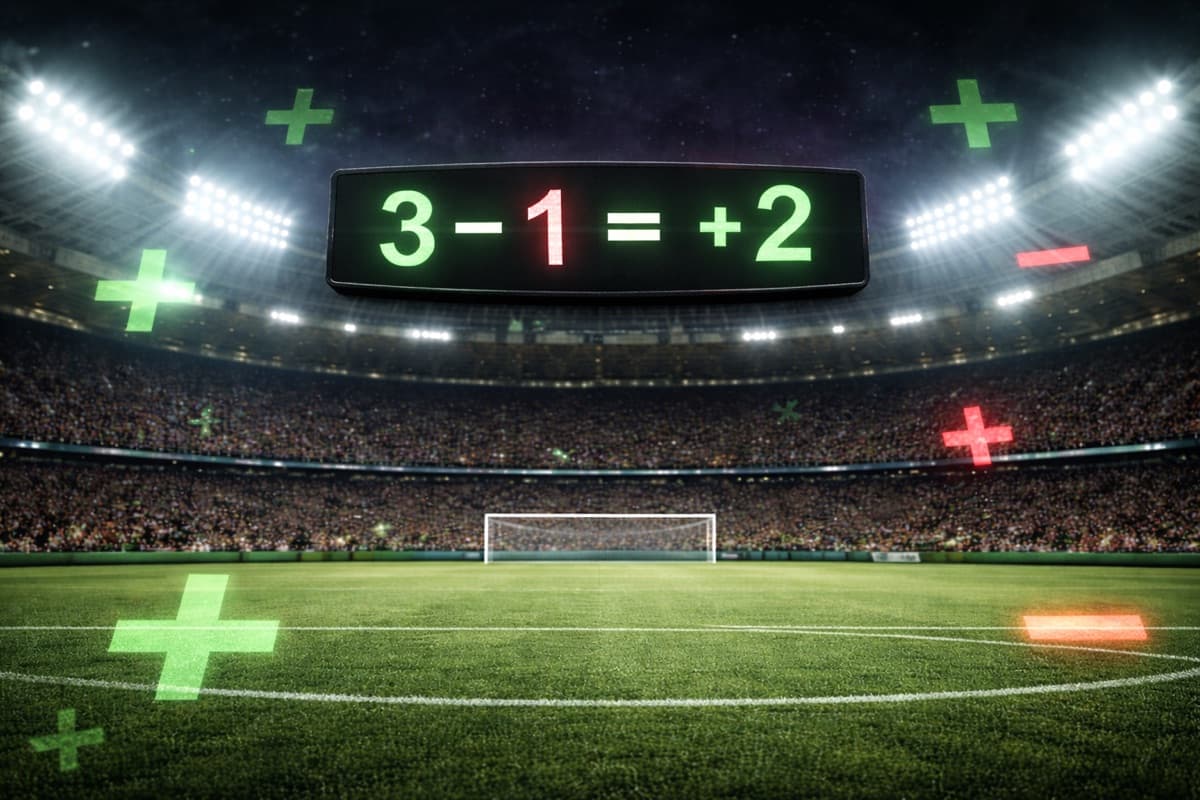
Goals Plus Minus (G±) in Football: Definition, Strengths, Limitations and Its Role in Modern Player Evaluation
Goals Plus Minus (G±) in football measures the average goal difference per game while a player is on the pitch. Instead of focusing on individual actions such as goals, assists or passes, the metric evaluates how the team performs on the scoreboard during a player’s playing time. If a team scores more goals than it concedes while a player is involved, the value is positive. If the team concedes more than it scores, the value is negative.
The calculation requires only basic match data: starting lineups, substitutions, and goal minutes. For every minute a player is on the field, the team’s goal difference is tracked and aggregated across matches. To reduce volatility, many implementations apply minimum minute thresholds (for example, only matches with at least 30 minutes played) and limit extreme single-game values. Because it relies on widely available data, Goals Plus Minus can be calculated for almost any professional league and even for many lower divisions worldwide.
Strengths of Goals Plus Minus as a Football Metric
Goals Plus Minus offers an indirect link between player participation and match outcomes. Rather than isolating individual actions, it reflects the collective performance of the team during a player’s minutes. Its main strengths include:
- Direct outcome focus: The metric aligns with the fundamental objective of football scoring more goals than the opponent.
- Two-sided impact: Offensive and defensive contributions are reflected simultaneously in the goal difference.
- Methodological transparency: The calculation is simple and understandable without complex modeling.
- Broad applicability: It can be applied to leagues with limited data availability.
- Potential to highlight structural contributors: Players whose influence is tactical or organizational rather than statistical may still show consistent positive values.
These strengths make G± a useful descriptive tool within a broader analytical framework.
Weaknesses and Limitations of Goals Plus Minus in Soccer
Despite its intuitive structure, raw Goals Plus Minus has several important limitations that must be considered when interpreting the metric:
- Team-strength bias: Players in strong teams are more likely to record high values due to overall team dominance.
- Low-scoring volatility: In football, single goals can significantly affect averages, especially in smaller samples.
- Lineup dependency: Teammates, tactical systems and opponent quality influence the goal difference during a player’s minutes.
- Limited causal insight: The metric shows what happens on the scoreboard, but not why it happens.
- Sample size sensitivity: Short-term runs of form can distort values without sufficient match volume.
For these reasons, G± should not be interpreted as a standalone measure of individual quality, but rather as an outcome-based indicator that requires context and a wide range of games against different opponents.
When Goals Plus Minus is most vailable
Players from top-performing clubs often dominate the upper end of the table, reflecting their teams' consistent positive goal differences. At the same time, within those teams, variations between players can still be observed, so the metrics is most valuable to compare payers inside a team. The player with the highest Goals Plus Minus value in a team, has a more positive impact on the result than a player with a Goals Plus Minus value belwo the team average. See the overview of some Bayern München players. You see, that Luiz Diaz, Harry Kane and Manuel Neuer have a far better valeu than e.g. Tom Bischof, Leon Goretzka or Min-jae Kim and thereby a more positive impact on the result. When Luis Diaz is on the pitch, the goal difference is on average +2 goals. However, it has to be considered, that Luis Diaz only participated in 21 Bundesliga games up to this point and the values for players with e.g. 50 games is more meaningful.
**Goals Plus Minus of FC ayern München players (February 2026)**
| Player Name | Position | G± |
|---|---|---|
| Luis Díaz | Left Wing | +2.05 goals |
| Harry Kane | Centre-Forward | +1.88 goals |
| Manuel Neuer | Goalkeeper | +1.70 goals |
| Michael Olise | Right Winger | +1.67 goals |
| Konrad Laimer | Midfielder | +1.61 goals |
| Dayot Upamecano | Centre-Back | +1.58 goals |
| Joshua Kimmich | Right-Back | +1.56 goals |
| Josip Stanišić | Centre-Back | +1.54 goals |
| Raphael Guerreiro | Defender | +1.44 goals |
| Serge Gnabry | Right Winger | +1.39 goals |
| Aleksandar Pavlović | Defensive Midfield | +1.29 goals |
| Jonathan Tah | Centre-Back | +1.28 goals |
| Min-jae Kim | Centre-Back | +1.28 goals |
| Leon Goretzka | Central Midfield | +1.14 goals |
| Tom Bischof | Midfielder | +0.10 goals |
Check footballgap.com/en/Bundesliga/players (max. 50 games per player considered)
Why Goals Plus Minus Matters and How It Forms the Foundation for Football GAP
Goals Plus Minus matters because it shifts the analytical perspective from isolated actions to collective outcomes. It asks a straightforward question: does the team tend to outscore opponents when a specific player is on the field? While this does not fully separate individual impact from team context, it establishes a measurable link between player participation and results with enough games at hand.
At the same time, the limitations of raw G± make clear that additional contextualization is necessary. Team strength, teammate effects and competition level must be considered to better understand relative performance. This is where more advanced approaches, such as contextual adjustments and comparative models, build upon the basic plus minus concept. In this sense, Goals Plus Minus serves as a structural foundation: it provides the outcome-based core from which more refined metrics — such as our metric Football GAP (Game Advantage Percentage) — can further differentiate individual impact within and across teams. Learn how Football GAP is enhancing Goals Plus minus in this article.
Recent Articles

GAP Explained
What is Plus Minus Goals (G±)?
Plus Minus Goals (G±) is the average goal difference per game while the player was on the pitch. A value above 0 indicates that the team rather wins, a value below 0 means his team concedes more goals than they score when the player is on the pitch. As an example, if the player's team is winning 3:1 the goal difference is +2, if the player's team is loosing 0:1, the goal difference is -1. It is a pure metric which is barely adjusted for game context.
What is GAP?
GAP (Game Advantage Percentage) shows the percentage gap between a player and the average league player. It answers the question: How much does a player improve or worsen a team's performance? It is based on high level game data with a focus on the impact on the goal difference (G±) from the last 50 games of a player. Besides that, GAP goes further and considers game context by involving data from the player and all other players who are at the same time on the pitch, no matter if teammates or opponents. Football GAP - the individual metric for team players.