Mind the (Football) GAP - How to measure which footballers really make their team better
How Goals Plus Minus set the foundation to measure football player’s real impact
January 20, 2026

What distinguishes a good player from a difference maker? Maybe you are just checking the recent scoresheets, seeing who scored the most goals or delivered the most assists. You have read about pass completion rates, distance covered, and tackles won. And now you are wondering: does this actually tell me if the player helped the team win?
For decades, we have judged footballers by individual vanity metrics. But individual statistics like goals, assists or passes only tell part of the story. What really matters is often neglected: The contribution to team success. Let’s answer a simple question: Is a player making the team better or not?
How are current football metrics treated
Even though data analytics in football has developed substantially and there are now valuable deeper statistics available to the top teams, as you can read about in “How to win the premier league”. These valuable data insights are not available to everyone and thus the public discourse still clings to the same old pillars. Which player scores the goals, who looks good in the dribblings or has a high passing completion rate. If these players really benefit to the team’s success is sometimes questionable: Are they taking care of their defensive obligations, do the passes cover any ground and pass opponents or does a player have a positive impact on their own teammates or not.
As most stats focus mainly on the individual, the information around the actual influence on the result is restricted. This is where Goal Plus Minus and GAP come into action and tackle these issues from an outcome perspective.
The Foundation: Goals Plus Minus (G±)
The concept is simple and surprisingly underused in football compared to basketball or ice hockey. Plus Minus Goals measure the average goal difference per game while the player was on the pitch.
- Positive value: The team scores more than they concede while a player is on the pitch.
- Negative value: The team concedes more than they score while a player is on the pitch.
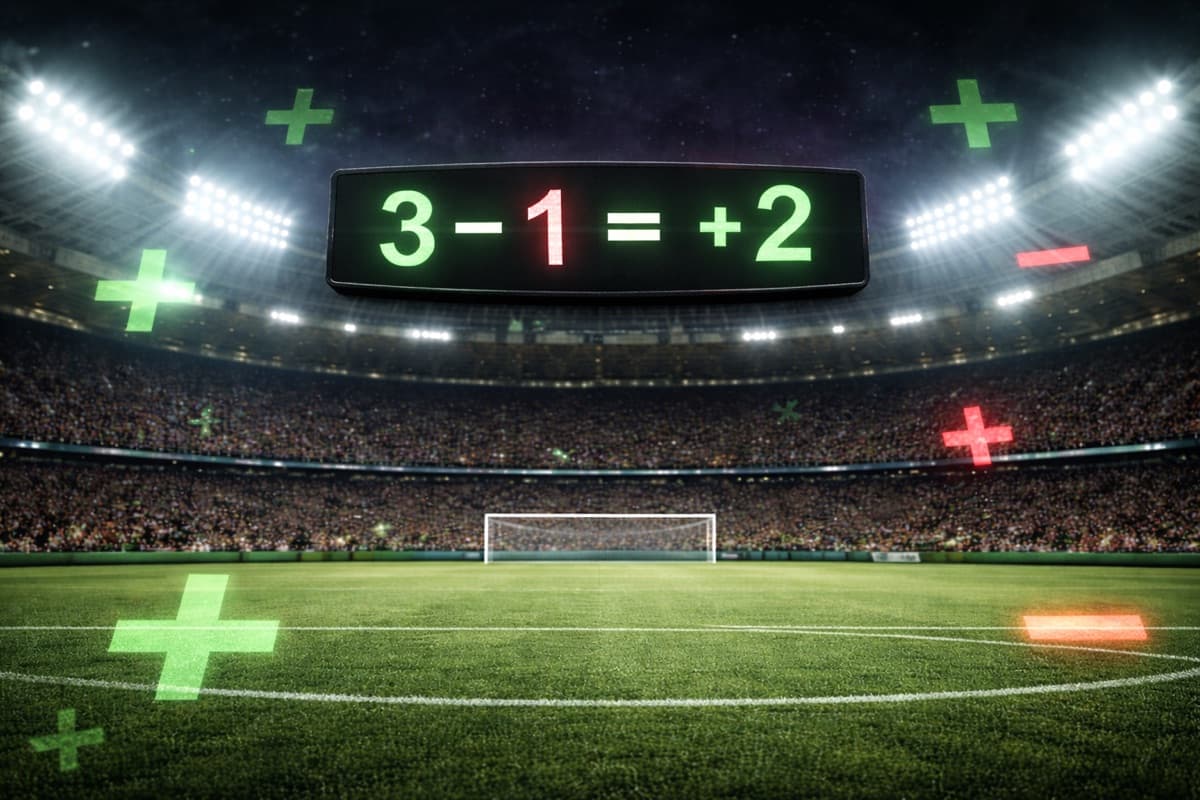
It is a pure metric and captures only the goal difference while the player was on the pitch. If a team wins 3:1, the Plus Minus value is +2. If the team loses 0:1, the Plus Minus value is -1.
Adding Context: Game Advantage Percentage (GAP)
The PLus Minus Goals are a great start, but it has some flaws: it is biased by team strength. A mediocre player in a dominant team like Manchester City will naturally have a high Plus Minus Goals value. This is where GAP comes into play.
The key elements are the Plus Minus Goals values and secondly, the player’s difference to their teammates. The metric takes into account that players from stronger teams are naturally getting more points but it is harder to stand out in comparison to their teammates. On the other hand stronger players in weaker teams will stand out more in comparison to their teammates performance, but will have in general a lower plus minus value.
GAP filters out the noise. It highlights the center-back at a mid-table club who transforms a leaky defense into a fortress, just as clearly as it highlights the star winger who assists the top striker. By providing this impact-based perspective, we give the "invisible" players the credit they deserve. To summarise: Game Advantage Percentage (GAP) reveals the gap between a player and the average league player.
What has to be considered
Like all other metrics also G± and GAP have their weaknesses. In general, metrics should always be interpreted in an overall context and it is valuable to take multiple metrics rather than one metrics into account. Our model is based on lineups, goals, substitutions and red cards, that's it. This simplicity makes the metrics applicable for a lot of cases, so that the data can be created for every league and league level in the world with just minimum data input. We believe with enough games at hand, the impact of a player will always be reflected with our metrics and there are only a few exceptions where it might not. We account for game difficulty, recent forms and who the teammates on a certain gameday are, still in football there are many variables which might distort this information on specific dates. Thus, as always when analysing data, the more data points we have, the better the insights will be.
Who are current football’s game changers?
See here the current (status from January 19, 2026) top 5 players from the top leagues based on Football GAP. You can interpret the GAP values as the perentage a player adds to the performance of a team compared to an average league player:
| Rank | Premier League | GAP | Bundesliga | GAP | La Liga | GAP | Serie A | GAP |
|---|---|---|---|---|---|---|---|---|
| 1 | Ruben Dias | +8.1% | Harry Kane | +11.3% | Lamine Yamal | +9.7% | Amir Rrahmani | +6.4% |
| 2 | Gabriel Magalhães | +6.9% | Luis Díaz | +8.9% | Raphinha | +7.6% | Scott McTominay | +6.0% |
| 3 | Bukayo Saka | +6.4% | Michael Olise | +8.7% | Kylian Mbappé | +7.3% | Yann Sommer | +5.7% |
| 4 | Jérémy Doku | +6.1% | Joshua Kimmich | +8.6% | Pau Cubarsí | +7.0% | Marcus Thuram | +5.6% |
| 5 | Alisson Becker | +5.8% | Manuel Neuer | +8.1% | Jules Koundé | +6.8% | Marten de Roon | +5.4% |
See all Top 150 players: Premier League | Bundesliga | La Liga | Serie A
The vision
How does the list at the top look to you? Do you find players as the most valuable by GAP, you would have expected in the list? For top leagues you have nowadays all the data available, like possession, shots taken or even expected goals. None of this is available for most of the lower football leagues in the world. As the data foundation for the calculation of GAP is very light and just needs standard game information as lineups, substitutes and when goals are scored as a minimum requirement, Football GAP can be calculated for every league where this data is available. Football GAP, the individual metric for teamplayers, should be available for every football player in every league in the world.
Recent Articles
GAP Explained
What is Plus Minus Goals (G±)?
Plus Minus Goals (G±) is the average goal difference per game while the player was on the pitch. A value above 0 indicates that the team rather wins, a value below 0 means his team concedes more goals than they score when the player is on the pitch. As an example, if the player's team is winning 3:1 the goal difference is +2, if the player's team is loosing 0:1, the goal difference is -1. It is a pure metric which is barely adjusted for game context.
What is GAP?
GAP (Game Advantage Percentage) shows the percentage gap between a player and the average league player. It answers the question: How much does a player improve or worsen a team's performance? It is based on high level game data with a focus on the impact on the goal difference (G±) from the last 50 games of a player. Besides that, GAP goes further and considers game context by involving data from the player and all other players who are at the same time on the pitch, no matter if teammates or opponents. Football GAP - the individual metric for team players.